

The year 2025 marked a turning point for Bitcoin, with rapid progress in infrastructure, regulation, and institutional adoption advances that once seemed unrealistic. Growing mainstream validation, increasing independence from traditional markets, and broader acceptance have strengthened Bitcoin’s long-term outlook. Together, these factors position Bitcoin to compete with gold in market value and reinforce the strongest bull case it has ever had.
On 22nd December 2025, Bitcoin rose back above $90,000 per token on Monday morning as investors look back on a highly volatile year for the digital asset, which has seen a broad sell-off since hitting its record high above $126,000 in early October.
Short-term price drops in Bitcoin often trigger fear among retail investors, but history shows these pullbacks are a normal and healthy part of every major bull run. Volatility does not signal weak fundamentals; rather, it reflects natural price discovery. When price action is set aside, Bitcoin’s underlying strength remains solid across nearly all metrics.
Key takeaways
• The Trump’s effect on Bitcoin.
• The bullish trend that shaped the sentiments of Crypto enthusiasts.
• The bearish phase appears again.
The Trump’s Effect
Donald Trump is known for fueling volatility in financial markets. When he won his first election, markets rallied on expectations of huge tax cuts and financial deregulation. Now, his second election victory is raising certain asset prices, with cryptocurrencies as one of the main beneficiaries. In 2024, the combined value of all digital currencies rocketed from $1.6 trillion to $3.29 trillion, and Bitcoin, the industry’s poster child, hit a new high just above $100,000.12 Crypto prices began rising again toward the end of 2023. But the biggest gains were seen after Trump won the election, following a campaign in which he promised to be the “crypto president.”
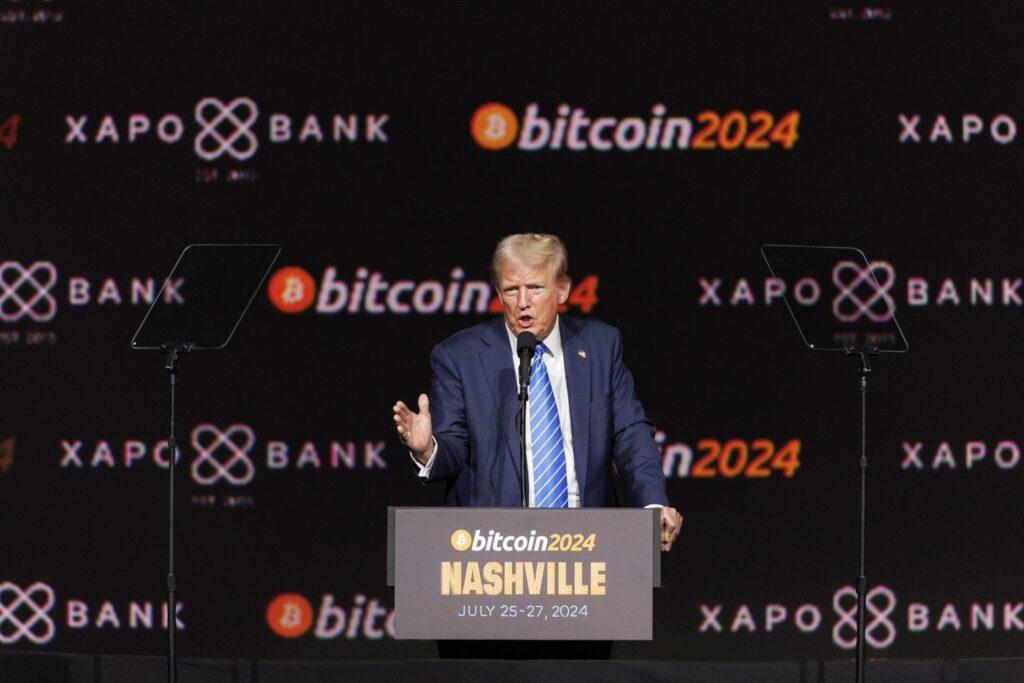
Trump at the Bitcoin conference 2024
In early November 2024, just before Trump’s election victory, Bitcoin traded at about $68,300. Not long after, the price soared beyond $100,000, with analysts citing Trump’s victory as a catalyst. Other cryptocurrencies also rose sharply, as did investments in crypto-related companies.
However, Trump’s influence on crypto appears to have been driven partly by market momentum. As that momentum fades, prices may decline and this process seems to have already started, although the pullback has been gradual so far.
The Bullish Trends That Shaped the Sentiment of Crypto Enthusiasts in 2025
The year 2025 marked a defining chapter for the cryptocurrency market, reigniting optimism among crypto enthusiasts after periods of uncertainty in previous years. Several key bullish trends combined to restore confidence, attract new participants, and reinforce belief in crypto’s long-term potential.
One of the strongest drivers of bullish sentiment was increased institutional adoption. Major financial institutions expanded their exposure to digital assets through spot ETFs, custody services, and blockchain-based financial products. This shift helped legitimize crypto in the eyes of traditional investors and reduced the perception of digital assets as purely speculative instruments.
Bitcoin’s performance in 2025 provided some of the clearest evidence of renewed enthusiasm. The leading cryptocurrency hit a series of new all-time highs, each helping to fuel investor confidence:
- It first broke past $109,000 on May 21, 2025, setting a fresh record above prior peaks.
- This was followed by another milestone around July 9, 2025, when Bitcoin climbed to about $112,000.
- In mid-July, the price surged past $118,000 on July 11, 2025.
- Next, Bitcoin crossed $120,000 on July 14, 2025, reaching a record just above $123,000.
- The biggest peak came in early October, when Bitcoin surged to approximately $125,000 on October 5–6, 2025, its highest level of the year.
These milestones helped shape the broader narrative of 2025 as a breakout year for crypto, even as prices later softened from their peaks. Together, these trends shaped a renewed bullish outlook in 2025.
The Bearish Phase Appears Again
After months of optimism and strong rallies, the crypto market is once again showing signs of a bearish phase. Prices across major digital assets have softened, trading volumes have declined, and investor sentiment has shifted from excitement to caution. While this downturn may feel abrupt, it follows a familiar pattern seen throughout crypto’s history.
A clear signal of this shift has been Bitcoin’s price behavior. On February 26, 2025, Bitcoin dropped about 5% to around $84,201, a notable correction that reflected rising risk aversion and broader market weakness.
Beyond this specific drop, the market has seen broader sell-offs and deeper drawdowns throughout the year. By April 2025, Bitcoin’s price had fallen significantly from its earlier peaks, erasing gains and testing key support levels. In October 2025, the downward pressure intensified during a steep correction to $90,000 from $125,700 after the cryptocurrency’s rally earlier in the year, contributing to further losses and market volatility.
Several forces are behind this renewed downturn:
▪︎ Fading Momentum: The strong upward thrust that drove prices earlier in the year has weakened, and traders have taken profits or exited positions, contributing to selling pressure.
▪︎ Macro & Regulatory Uncertainty: Global economic uncertainty, including shifting interest rate expectations, trade tensions, and delayed regulatory clarity in key markets, has dampened risk appetite.
▪︎ Market Structure & Liquidity: Increased correlation with traditional financial markets has amplified volatility, as risk assets including equities and crypto have moved more in tandem.
Despite the downturn, a bearish phase does not necessarily signal the end of crypto’s long-term growth. Historically, bear markets have served as periods of consolidation, innovation, and structural strengthening.
While the current environment may test investor patience, it also reinforces a core lesson of crypto markets: cycles are inevitable. For long-term participants, bearish phases are not just periods of decline but moments of reflection, resilience, and preparation for the next shift in momentum.


Leave a Reply