
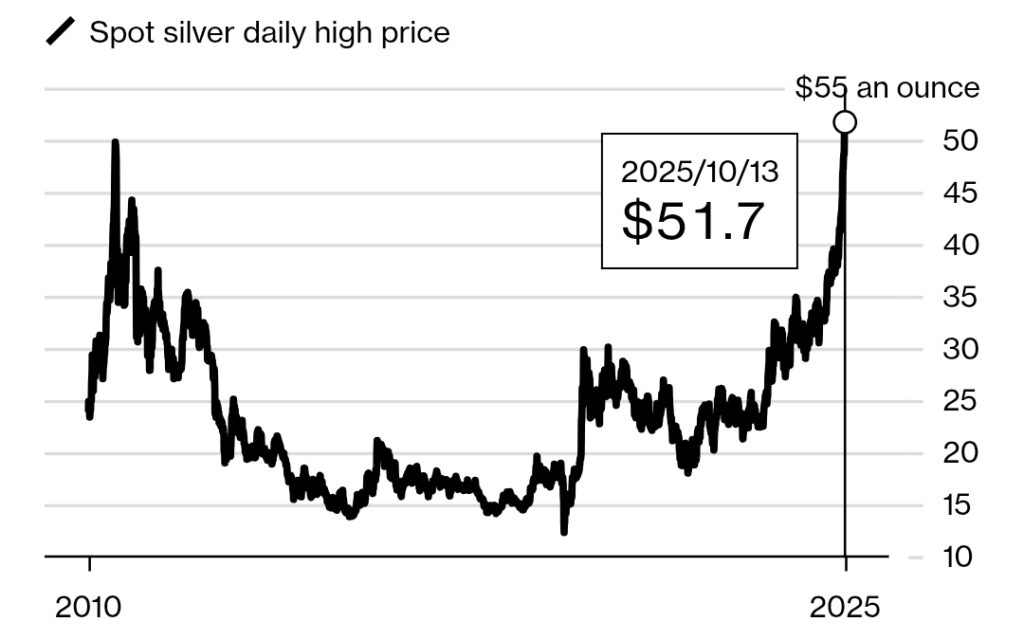
Silver — one of the world’s most actively traded commodities is projected by experts to potentially surpass its 1980 and 2011 record highs as it nears $50 in 2025. The metal has already risen 55% this year, from $29 in January to nearly $47 in September, marking its highest quarterly close on record. This surge is fueled by safe-haven demand, Federal Reserve rate cuts, ongoing supply shortages, and record industrial demand from sectors like solar energy and electric vehicles.
Gold has surged this year due to global instability and economic uncertainty, but silver has outperformed it with a 70% gain versus gold’s 55%. The rise is driven by strong investor demand for safe-haven assets amid inflation and political tensions. Unlike gold, silver’s industrial uses and dwindling inventories have heightened concerns about potential supply shortages affecting various industries.
Key takeaways
• The demand for Silver outperformed Gold in percentage terms.
• What makes the Silver market unique?
• What this breakthrough mean for industries that rely on Silver.
Source: Bloomberg
Silver safe-haven demand and its buyers
Silver’s surge has been reinforced by safe-haven flows tied to U.S. political uncertainty. Ahead of midnight on 30 September, fears of a government shutdown saw investors shift into gold and silver. Analysts agree the risk alone – even without an actual shutdown – heightened demand as markets priced in disruption to government services and data releases.
At the same time, geopolitical tensions, from renewed fighting in Ukraine to conflict risks in the Middle East, add to silver’s safe-haven appeal alongside gold.
Silver is an excellent electrical conductor that’s used in circuit boards and switches, electric vehicles, batteries and solar panels. It’s also used in coatings for medical devices. And like gold, it’s still a popular ingredient for making jewelry and coins. As a tradable asset, it’s cheaper than gold per ounce, making it more accessible to retail investors, and its price tends to move more sharply during precious metal rallies.
China and India remain the top buyers of silver, thanks to their vast industrial bases, large populations and the important role that silver jewelry continues to play as a store of value passed down the generations.
Governments and mints also consume large quantities of silver to produce bullion coins and other products.
What makes the Silver market unique?
Silver’s varied uses mean its market price is influenced by a wide array of events including shifts in manufacturing cycles and interest rates and even renewable energy policy. When the global economy accelerates, industrial demand tends to push silver higher. When recessions loom, investors often step in as alternative buyers.
The market is thinner than with gold. Daily turnover is smaller, inventories are tighter and liquidity can evaporate quickly. That isn’t because there is less silver than gold available for trading. In fact, it’s the opposite: There are about 790 million ounces of silver in vaults overseen by the London Bullion Market Association, compared with 284 million ounces of gold. But silver is far less valuable per weight. The silver stored in London is worth about $40 billion, while the gold is worth $1.1 trillion.
What does this mean for industries that rely on silver?
Some traders have been booking space on transatlantic cargo flights for bulky silver bars — an expensive transport method typically reserved for gold to capture price differentials between London and New York.
For sectors like solar panel manufacturing, in which silver paste is a critical ingredient, sustained high prices could begin to erode profitability and spur efforts to substitute silver components for other metals.


Leave a Reply